| RFID Implant Tracks Reflux with Accuracy and Comfort |
R&D DIGEST
![]() |
|
The small radio-frequency monitor measures both acid and nonacid reflux.
|
A wireless implant that monitors
esophageal reflux could produce
more-accurate results for doctors and
more comfort for patients than current
technology. The device incorporates
radio-frequency identification
(RFID) and tests for electrical impulses
that indicate acid and nonacid reflux.
Information is transmitted to a
sensor worn outside of the body.
The patent-pending device aims to
solve two key design issues in monitoring
reflux—accuracy and patient
comfort. “For esophageal cancer
screening, the endoscopy and catheter
process is [often] too painful for patients,
so by the time they go into the
doctor and find out they have cancer,
it's too late,” says Jung-Chih Chiao,
PhD, associate professor at the University
of Texas at Arlington. “If there's
a comfortable and more convenient
way for the patient, then more [individuals]
who have even minor symptoms
of heartburn might want to do
this screening.”
In addition to the discomfort experienced
by some patients, current approaches
don't address both acid and
nonacid reflux. Currently, a catheter is
inserted through the patient's nose and
into the esophagus. This makes it difficult
for the patient to continue normal
activity, which in turn gives doctors
less-accurate measurements. A
wireless monitoring system that's
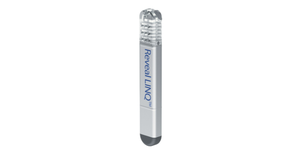
about the size of a vitamin pill is already
on the market, but it doesn't
measure nonacid reflux, says Chiao.
Chiao and his colleagues at the University
of Texas Southwestern Medical
Center (UT Southwestern; Dallas)
are confident that their device, which
doesn't require a catheter, can distinguish
air, water, and different types of
acid. The wireless sensor uses impedance
monitoring to detect nonacid reflux.
“Impedance sensing is accurate
because we can sense the direction of
the food flow,” says Chiao.
![]() |
|
The team at UT Southwestern Medical Center includes (from left to right)
Jung-Chih Chiao; H. F. Tibbals, PhD; and Shou-Jiang Tang, MD. |
To refine the design, the team created
three generations of prototypes.
The first 2 × 2-cm sensor is built on a
flexible substrate, which allows it to
be rolled up and then inserted into the
esophagus. There, it attaches to the
esophageal wall and an inductive antenna
resonates with a wireless device
outside of the body. This beeper-type
device receives electromagnetic signals
from the esophagus and stores
the data. Doctors could download the
information, and a computer could
analyze the data. No battery is needed,
and the sensor lasts more than 48
hours.
The second-generation sensor, about
the size of a capsule, incorporates an
RFID chip. The chip identifies the position
of the implant and provides a secure
communication with the external
reader. It also eliminates motion artifacts,
which can cause false readings.
For the third-generation sensor, researchers
used a thermal-treated polymer
that is biocompatible and resists
acid. They tested it to withstand more than 2 weeks in the body. Their target
size for the unit, which Chiao hopes to
use for animal tests, is 0.8 × 0.5 cm.
The next challenges include making
the unit disposable and finding an inexpensive
manufacturing method. The
researchers have also been working
closely with doctors to make it easier to
attach to the esophageal wall.
Although the researchers aren't developing
software to work with the
chip, Chiao says that a device company's
involvement in designing that
component could help take the device
to the marketplace. Software would
have to be included in the final device
to handle the large amount of data
from the sensor. The signals need to be
coordinated with patient activity during
reflux or nonreflux situations, explains
Chiao.
The team is also looking at using the
device to diagnose other diseases.
“This is an enabler technology. Once
we establish the fundamentals, there
are a lot of [other] applications.”